Past Campaigns

The #WeCARE campaign was first launched in Fall 2019 with light pole banners across campus. The campaign was designed to change perceived social norms related to bystander intervention and encourage campus community members to intervene when they see SVSH. 
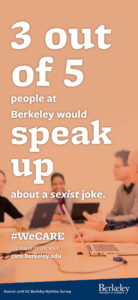
A poster with a warm orange overlay shows a blurred image of a group of students sitting around a table with laptops, appearing to be in a discussion or meeting.
Large white text reads: “3 out of 5 people at Berkeley would speak up about a sexist joke.”
The word “sexist” is italicized 
Below the main text, it reads: “#WeCARE.”
Under that, smaller text reads: “To learn more, visit care.berkeley.edu.”
At the bottom left, small text reads: “Source: 2018 UC Berkeley MyVoice Survey”
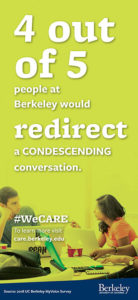
At the bottom right is the “University of California, Berkeley” logo. A poster with a bright yellow-green overlay shows a blurred image of two students sitting across from each other at a table with laptops, appearing to be in conversation.
Large white text reads: “4 out of 5 people at Berkeley would redirect a CONDESCENDING conversation.”
Below the main text, it reads: “#WeCARE.”
Under that, smaller text reads: “To learn more, visit care.berkeley.edu.”
At the bottom left, small text reads: “Source: 2018 UC Berkeley MyVoice Survey”
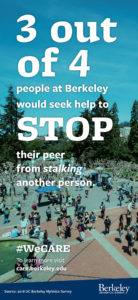
At the bottom right is the “University of California, Berkeley” logo. A poster with a blue sky background shows Sproul Plaza: a busy outdoor campus scene with many students walking, sitting, and gathering in an open plaza with trees and buildings in the distance.
Large white text reads: “3 out of 4 people at Berkeley would seek help to STOP their peer from stalking another person.”
Below the main text, it reads: “#WeCARE.”
Under that, smaller text reads: “To learn more, visit care.berkeley.edu”
At the bottom left, small text reads: “Source: 2018 UC Berkeley MyVoice Survey”
At the bottom right is the “University of California, Berkeley” logo.


Then in 2020 PATH to Care Center launched a social media phase of the campaign with specific messages for undergraduates, graduate students, faculty, and staff.

Square social media post with two-toned red background. At the top, large white lettering reads "SAY WHAT THE REST OF US ARE THINKING." In the center are a black rectangular speech bubble without words (implying a negative comment) and a white rectangular speech bubble overlapping it with black text reading: "Hey, can you maybe not?" Below is text that reads: "Most Berkeley undergrads would challenge a sexist joke". At the bottom left is smaller white text reading: “#WeCARE Data: 2018 UC Berkeley MyVoice Survey” and on the bottom right it reads: “PATH to Care Center care.berkeley.edu”Square social media post. At the top, large white lettering on a red background reads "SAY WHAT THE REST OF US ARE THINKING." In the center on a white background are a black rectangular speech bubble without words (implying a negative comment) and a red rectangular speech bubble overlapping it with white text reading: "Is that meant to be funny?" Below is text that reads: "3 out of 4 Berkeley staff would challenge a sexist joke." At the bottom left smaller white lettering on a red background reads: “#WeCARE Data: 2018 UC Berkeley MyVoice Survey” and on the bottom right it reads: “PATH to Care Center care.berkeley.edu”Square social media post with a red background. At the top, large white lettering reads "SAY WHAT THE REST OF US ARE THINKING." In the center are a black oval speech bubble without words (implying a negative comment) and a white oval speech bubble overlapping it with black text reading: "Really?! That’s not funny". Below is text that reads: "Most Berkeley grad students would challenge a sexist joke." At the bottom left smaller white text reads: “#WeCARE Data: 2018 UC Berkeley MyVoice Survey” and on the bottom right it reads: “PATH to Care Center care.berkeley.edu”Square social media post. At the top, large white lettering on a red background reads "SAY WHAT THE REST OF US ARE THINKING." In the center on a white background are a black oval speech bubble without words (implying a negative comment) and a red oval speech bubble overlapping it with white text reading: "Your joke earlier was inappropriate". Below is text that reads: "7 out of 10 Berkeley faculty would challenge a sexist joke." At the bottom left smaller white lettering on a red background reads: “#WeCARE Data: 2018 UC Berkeley MyVoice Survey” and on the bottom right it reads: “PATH to Care Center care.berkeley.edu”
Square social media post with two-toned bright green background. At the top, large white lettering reads "SAY WHAT THE REST OF US ARE THINKING." In the center are a black rectangular speech bubble without words (implying a negative comment) and a white rectangular speech bubble overlapping it with black text reading: "So anyway…" Below is text that reads: "77% of Berkeley undergrads would redirect the conversation when a peer is condescending about someone’s gender". At the bottom left is smaller white text reading: “#WeCARE Data: 2018 UC Berkeley MyVoice Survey” and on the bottom right it reads: “PATH to Care Center care.berkeley.edu”Square social media post. At the top, large white lettering on a bright green background reads "SAY WHAT THE REST OF US ARE THINKING." In the center on a white background are a black rectangular speech bubble without words (implying a negative comment) and a green rectangular speech bubble overlapping it with white text reading: "I need your help with a task". Below is text that reads: "87% of Berkeley staff would redirect the conversation when a colleague is condescending about someone’s gender". At the bottom left smaller white lettering on a red background reads: “#WeCARE Data: 2018 UC Berkeley MyVoice Survey” and on the bottom right it reads: “PATH to Care Center care.berkeley.edu”Square social media post with a bright green background. At the top, large white lettering reads "SAY WHAT THE REST OF US ARE THINKING." In the center are a black oval speech bubble without words (implying a negative comment) and a white oval speech bubble overlapping it with black text reading: "Let’s get back to the assignment". Below is text that reads: "80% of Berkeley grad students would redirect the conversation when a peer is condescending about someone’s gender". At the bottom left smaller white text reads: “#WeCARE Data: 2018 UC Berkeley MyVoice Survey” and on the bottom right it reads: “PATH to Care Center care.berkeley.edu”Square social media post. At the top, large white lettering on a bright green background reads "SAY WHAT THE REST OF US ARE THINKING." In the center on a white background are a black oval speech bubble without words (implying a negative comment) and a green oval speech bubble overlapping it with white text reading: "Let’s get back to the meeting agenda". Below is text that reads: "88% of Berkeley faculty would redirect the conversation when a colleague is condescending about someone’s gender". At the bottom left smaller white lettering on a green background reads: “#WeCARE Data: 2018 UC Berkeley MyVoice Survey” and on the bottom right it reads: “PATH to Care Center care.berkeley.edu”
Square social media post with two-toned blue background. At the top, large white lettering reads "SAY WHAT THE REST OF US ARE THINKING." In the center are a black rectangular speech bubble without words (implying a negative comment) and a white rectangular speech bubble overlapping it with black text reading: "I’m uncomfortable with how my roommate lurks on their ex’s profile". Below is text that reads: "3 out of 4 Berkeley undergrads would seek help to stop their friend from stalking someone". At the bottom left is smaller white text reading: “#WeCARE Data: 2018 UC Berkeley MyVoice Survey” and on the bottom right it reads: “PATH to Care Center care.berkeley.edu”Square social media post. At the top, large white lettering on a blue background reads "SAY WHAT THE REST OF US ARE THINKING." In the center on a white background are a black rectangular speech bubble without words (implying a negative comment) and a blue rectangular speech bubble overlapping it with white text reading: "What can we do about how our colleague is acting?" Below is text that reads: "76% of Berkeley staff would seek help to stop their colleague from stalking someone". At the bottom left smaller white lettering on a blue background reads: “#WeCARE Data: 2018 UC Berkeley MyVoice Survey” and on the bottom right it reads: “PATH to Care Center care.berkeley.edu”Square social media post with a blue background. At the top, large white lettering reads "SAY WHAT THE REST OF US ARE THINKING." In the center are a black oval speech bubble without words (implying a negative comment) and a white oval speech bubble overlapping it with black text reading: "I think their attention is unwanted. What should we do?" Below is text that reads: "3 out of 4 Berkeley grad students would seek help to stop their peer from stalking someone". At the bottom left smaller white text reads: “#WeCARE Data: 2018 UC Berkeley MyVoice Survey” and on the bottom right it reads: “PATH to Care Center care.berkeley.edu”Square social media post. At the top, large white lettering on a blue background reads "SAY WHAT THE REST OF US ARE THINKING." In the center on a white background are a black oval speech bubble without words (implying a negative comment) and a blue oval speech bubble overlapping it with white text reading: "We have to do something about their behavior. Who should we contact?" Below is text that reads: "Most Berkeley faculty would seek help to stop their colleague from stalking someone". At the bottom left smaller white lettering on a blue background reads: “#WeCARE Data: 2018 UC Berkeley MyVoice Survey” and on the bottom right it reads: “PATH to Care Center care.berkeley.edu”