Campaigns

#weCARE

Data shows that most UCB undergraduate men want to intervene. There are many ways to get involved:

  1. Share the campaign on social media and tell your own stories about times you’ve spoken up or taken action to interrupt harmful behavior – tag @PATHtoCareUCB #WeCARE
  2. Learn about the indirect and direct ways you can intervene at the Bears That Care page.
  3. Request a bystander intervention workshop or consultation for your community or organization.
  4. Work with us to develop a custom poster for your community!
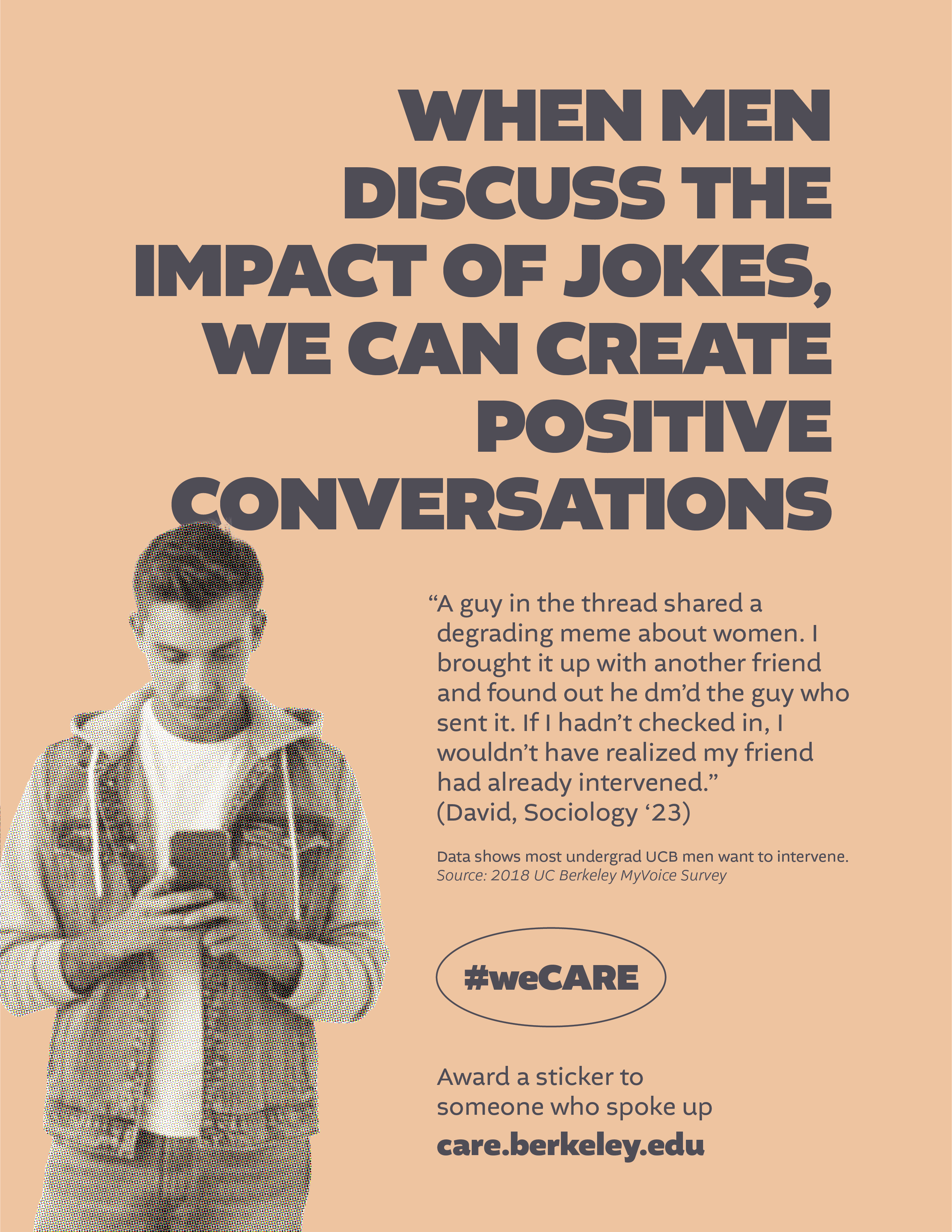
A light orange poster with bold dark gray text reads: “WHEN MEN DISCUSS THE IMPACT OF JOKES, WE CAN CREATE POSITIVE CONVERSATIONS.”
On the left side, there is a grayscale photo of a light skinned young man looking down at his phone, wearing a jacket layered over a hoodie.
On the right side, smaller text reads: “A guy in the thread shared a degrading meme about women. I brought it up with another friend and found out he dm’d the guy who sent it. If I hadn’t checked in, I wouldn’t have realized my friend had already intervened.” (David, Sociology ‘23)
Below the quote, small text reads: “Data shows most undergrad UCB men want to intervene. Source: 2018 UC Berkeley MyVoice Survey”
Centered underneath is a logo-style oval with the text: “#weCARE”
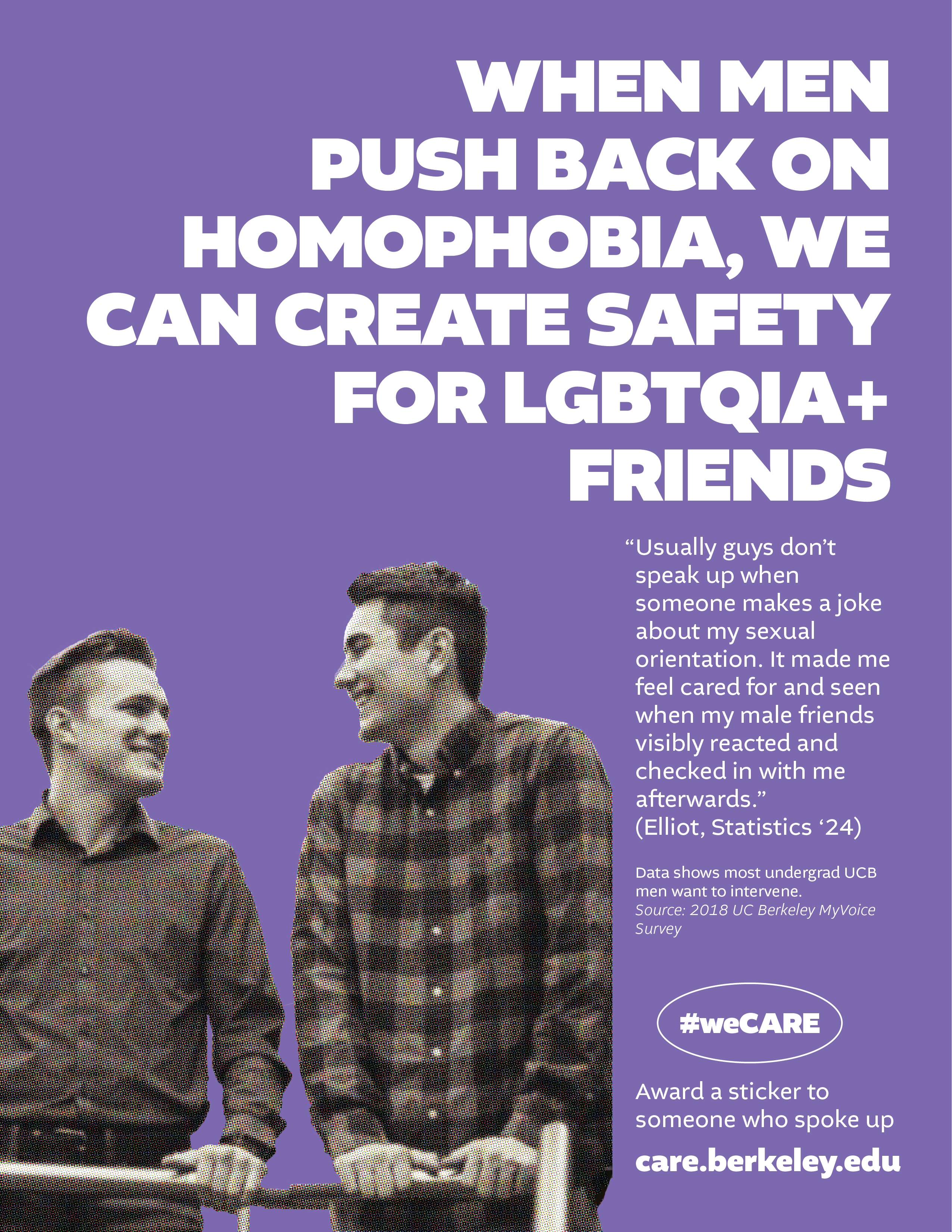
At the bottom, text reads: “Award a sticker to someone who spoke up care.berkeley.edu”A purple poster with large white text reads: “WHEN MEN PUSH BACK ON HOMOPHOBIA, WE CAN CREATE SAFETY FOR LGBTQIA+ FRIENDS.”
At the bottom left, there is a grayscale photo of two young, lighter skinned men smiling at each other while leaning on a railing, appearing relaxed and engaged in conversation.
On the right side, smaller text reads: “Usually guys don’t speak up when someone makes a joke about my sexual orientation. It made me feel cared for and seen when my male friends visibly reacted and checked in with me afterwards.” (Elliot, Statistics ‘24)
Below the quote, small text reads: “Data shows most undergrad UCB men want to intervene. Source: 2018 UC Berkeley MyVoice Survey”
Near the bottom is an oval with the text: “#weCARE”
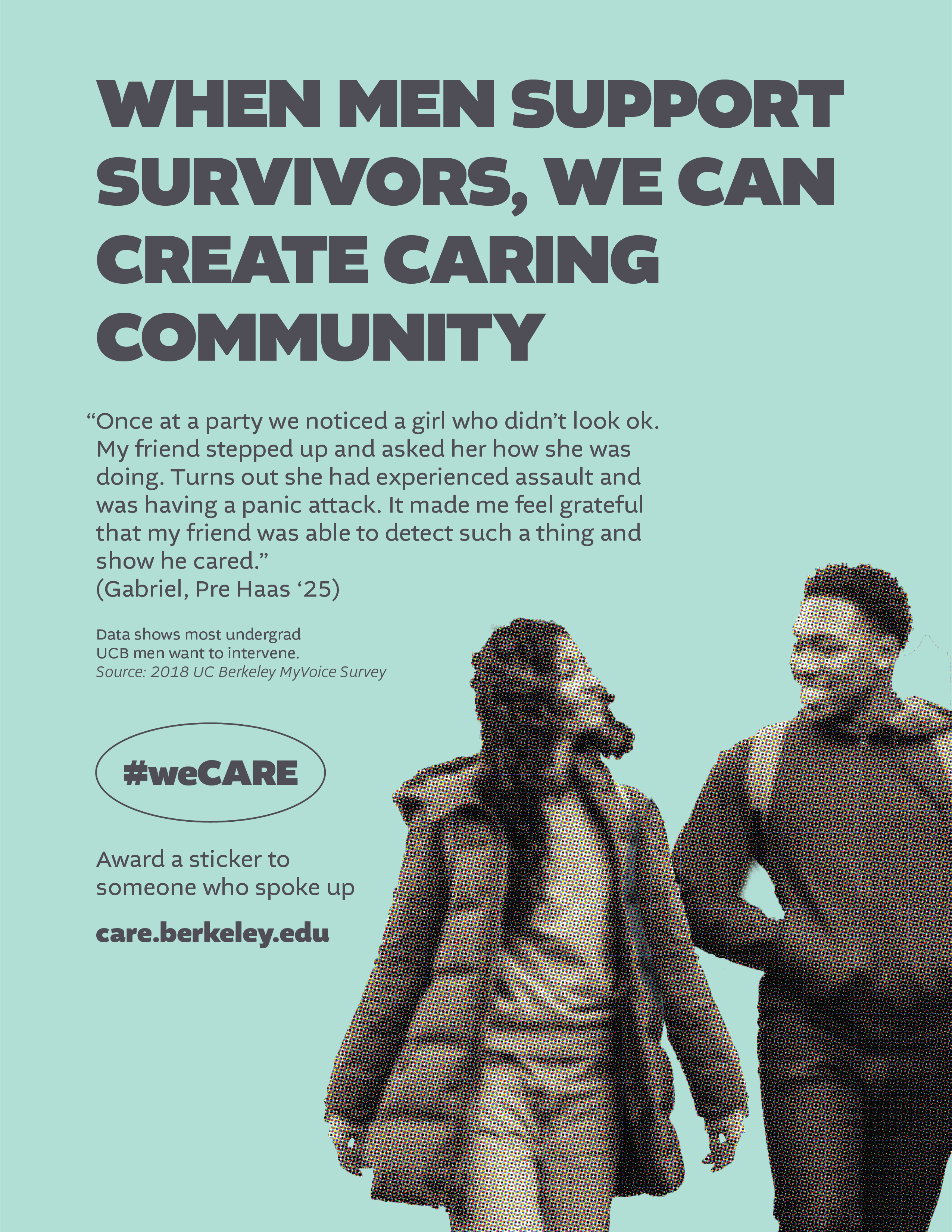
At the bottom, text reads: “Award a sticker to someone who spoke up care.berkeley.edu”A light teal poster with bold dark gray text reads: “WHEN MEN SUPPORT SURVIVORS, WE CAN CREATE CARING COMMUNITY.”
On the bottom right, there is a grayscale photo of two young people with dark skin walking side by side and smiling at each other, both wearing casual clothing and backpacks.
On the left side, smaller text reads: “Once at a party, we noticed a girl who didn’t look ok. My friend stepped up and asked her how she was doing. Turns out she had experienced assault and was having a panic attack. It made me feel grateful that my friend was able to detect such a thing and show he cared.” (Gabriel, Pre Haas ‘25)
Below the quote, small text reads: “Data shows most undergrad UCB men want to intervene. Source: 2018 UC Berkeley MyVoice Survey”
Below that is an oval with the text: “#weCARE”
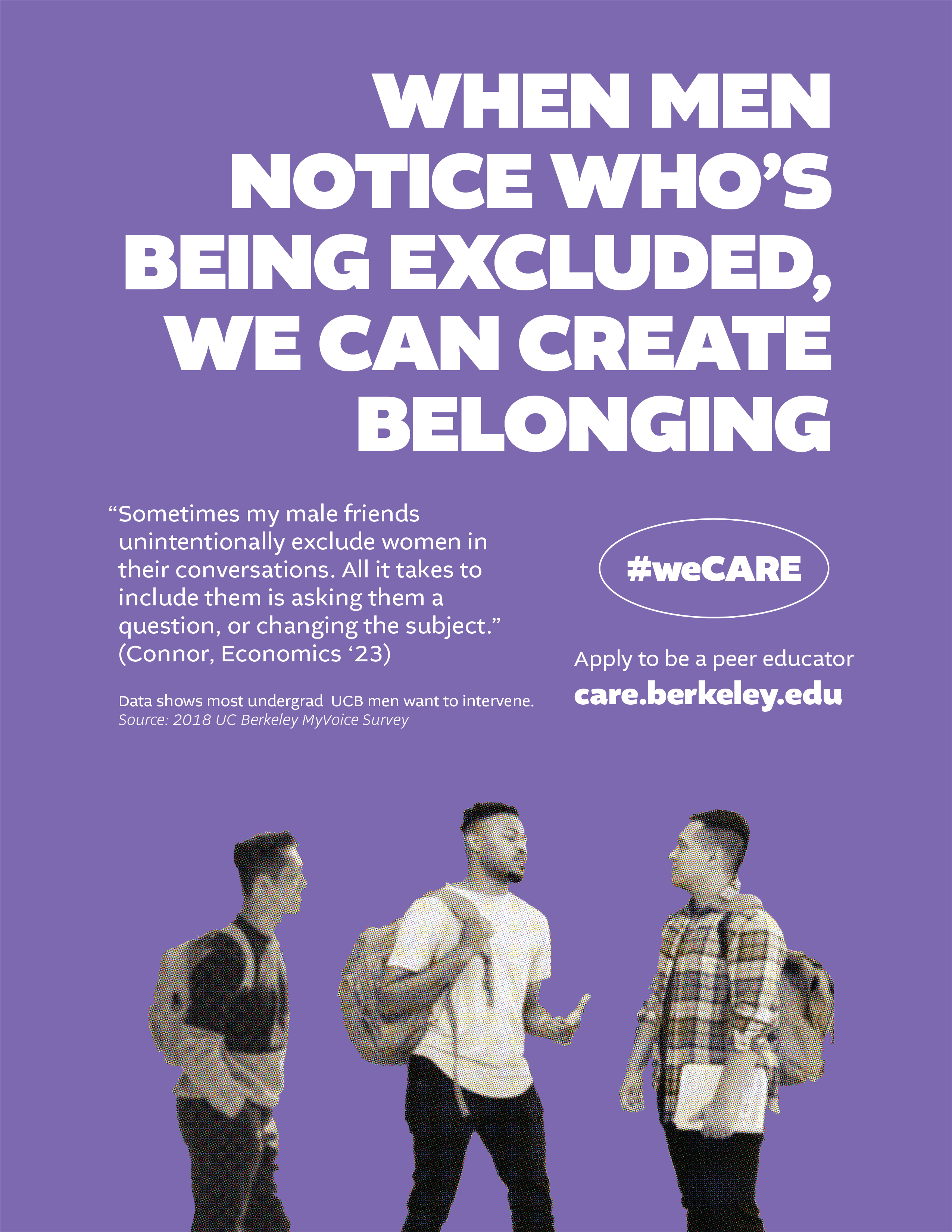
At the bottom, text reads: “Award a sticker to someone who spoke up care.berkeley.edu”A purple poster with large white text reads: “WHEN MEN NOTICE WHO’S BEING EXCLUDED, WE CAN CREATE BELONGING.”
At the bottom, there is a grayscale image of three young men of different races with backpacks talking together; one is gesturing while speaking, and the others are facing him, engaged in conversation.
On the left side, smaller text reads: “Sometimes my male friends unintentionally exclude women in their conversations. All it takes to include them is asking them a question, or changing the subject.” (Connor, Economics ‘23)
Below the quote, small text reads: “Data shows most undergrad UCB men want to intervene. Source: 2018 UC Berkeley MyVoice Survey”
On the right side is an oval with the text: “#weCARE”
Below that, text reads: “Apply to be a peer educator care.berkeley.edu”A light teal poster with bold dark gray text reads: “WHEN MEN MAKE SPACE FOR OTHERS’ VOICES, WE CAN CREATE SAFER CLASSROOMS.”
On the left side, there is a grayscale image of two male students of different races walking side by side. One is gesturing with their hand while the other looks down, holding a notebook.
On the right side, smaller text reads: “I was nervous to talk to my friend about how he interrupts women in our study group, but he was glad I did because he hadn’t realized he was doing it.” (Kartik, Chemistry ‘22)
Below the quote, small text reads: “Data shows most undergrad UCB men want to intervene. Source: 2018 UC Berkeley MyVoice Survey”
Below that is an oval with the text: “#weCARE”
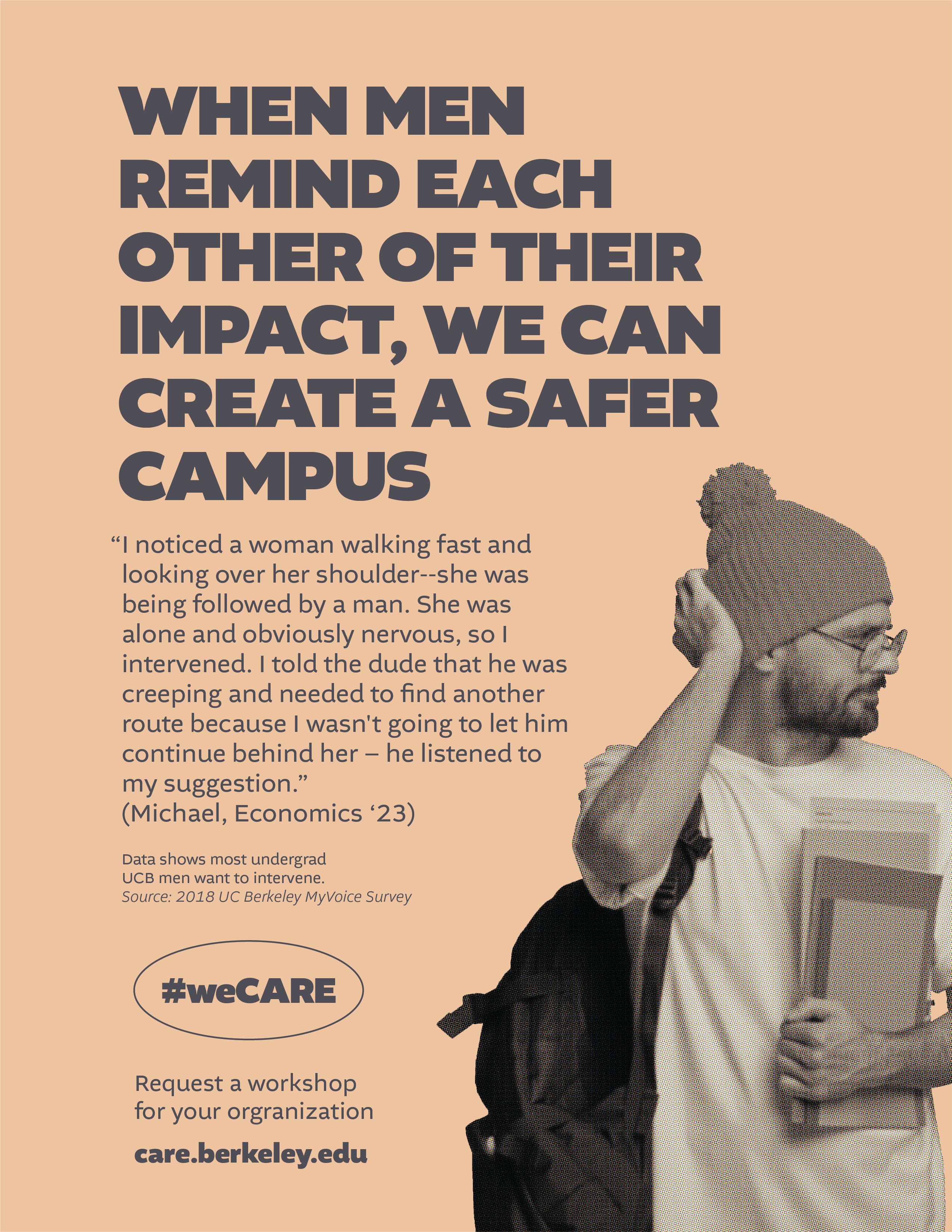
At the bottom, text reads: “Get involved at the PATH to Care Center care.berkeley.edu”A light orange poster with bold dark gray text reads: “WHEN MEN REMIND EACH OTHER OF THEIR IMPACT, WE CAN CREATE A SAFER CAMPUS.”
On the right side, there is a grayscale image of a young, lighter skinned man wearing a beanie and glasses, holding books and a backpack, looking off to the side while adjusting his hat.
On the left side, smaller text reads: “I noticed a woman walking fast and looking over her shoulder--she was being followed by a man. She was alone and obviously nervous, so I intervened. I told the dude that he was creeping and needed to find another route because I wasn’t going to let him continue behind her – he listened to my suggestion.” (Michael, Economics ‘23)
Below the quote, small text reads: “Data shows most undergrad UCB men want to intervene. Source: 2018 UC Berkeley MyVoice Survey”
Below that is an oval with the text: “#weCARE”
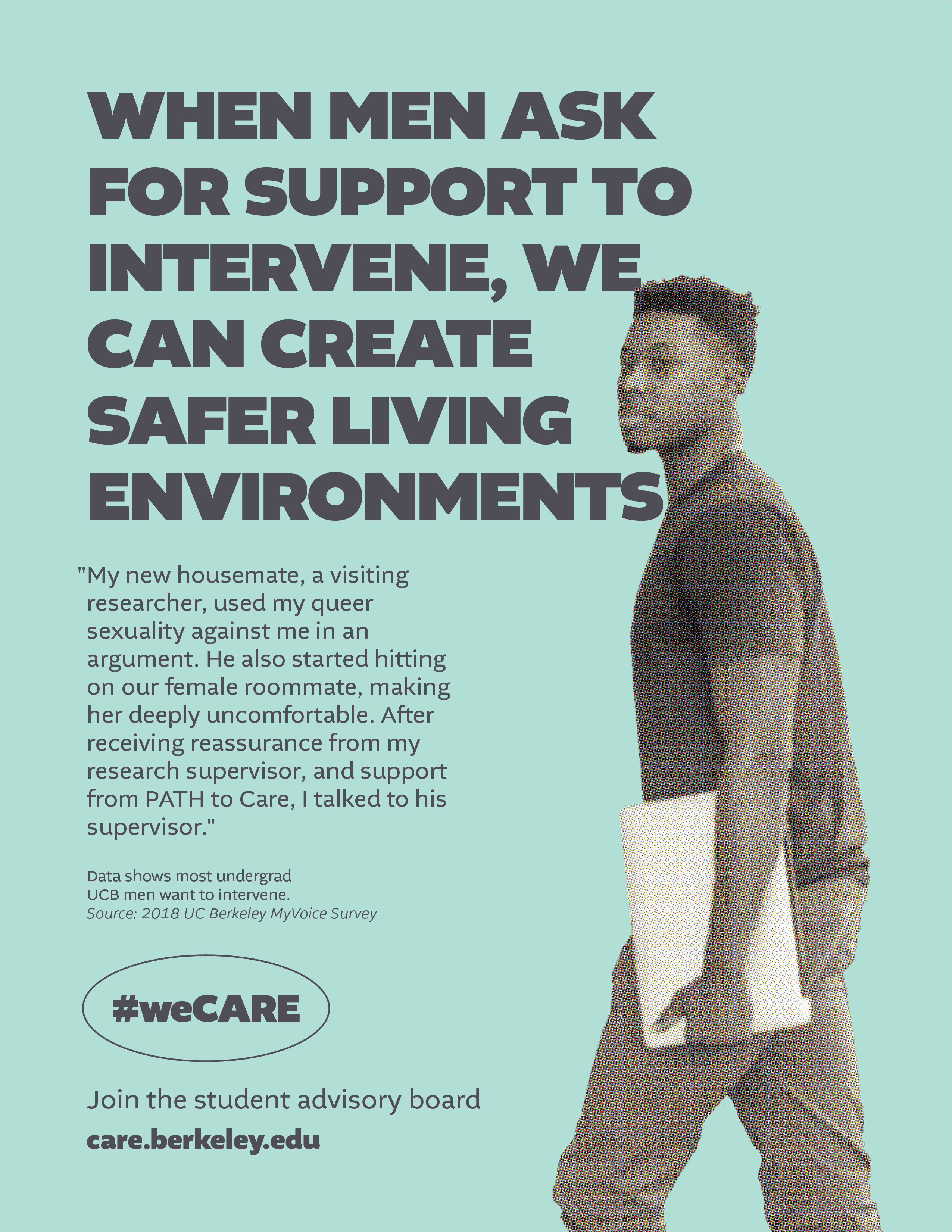
At the bottom, text reads: “Request a workshop for your organization care.berkeley.edu”A light teal poster with bold dark gray text reads: “WHEN MEN ASK FOR SUPPORT TO INTERVENE, WE CAN CREATE SAFER LIVING ENVIRONMENTS.”
On the right side, there is a grayscale image of a young Black man walking while holding a laptop, looking slightly to the side.
On the left side, smaller text reads: “My new housemate, a visiting researcher, used my queer sexuality against me in an argument. He also started hitting on our female roommate, making her deeply uncomfortable. After receiving reassurance from my research supervisor and support from PATH to Care, I talked to his supervisor.”
Below the quote, small text reads: “Data shows most undergrad UCB men want to intervene. Source: 2018 UC Berkeley MyVoice Survey”
Below that is an oval with the text: “#weCARE”
At the bottom, text reads: “Join the student advisory board care.berkeley.edu”

About Social Norms Campaigns

Social norms are the unwritten rules about how to behave, and most of us usually hold similar, healthy, positive views. But sometimes we think our peers hold different views based on a vocal minority that holds unhealthy attitudes. This misperception can make us less likely to act on our own values and beliefs.

Social norms campaigns use data from your own community to communicate the healthy attitudes of the majority, which encourages everyone to increase prosocial behavior. Learn more at the National Social Norms Center

Uplifting our values of respect, consent, and care for survivors is an important part of shifting the campus culture. The PATH to Care Center has led or contributed to a number of awareness and social norms campaigns.